01
High-stakes communication needed more trust
In healthcare, legal, education, and public service contexts, translation quality can directly affect someone’s ability to understand critical information.

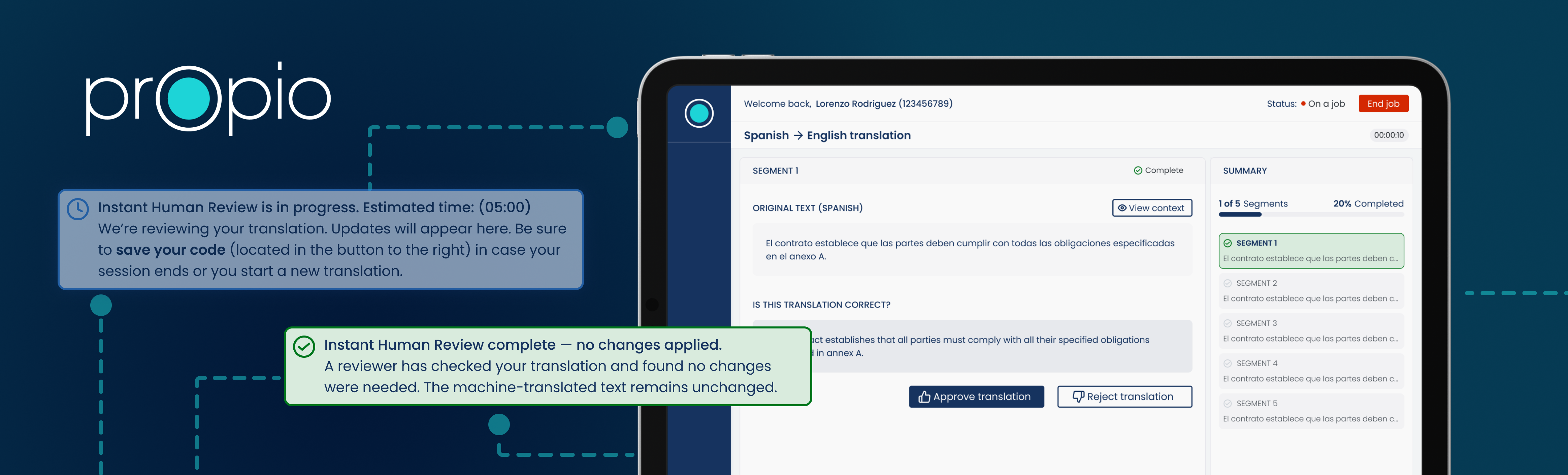
A market-first Propio initiative for AI-assisted translation review in regulated communication. Because the work is part of an active intellectual property conversation, this public version focuses on my role, design judgment, and product leadership without exposing the workflow, interface details, client data, or performance metrics.
Design Challenge
01
In healthcare, legal, education, and public service contexts, translation quality can directly affect someone’s ability to understand critical information.
02
The product needed to support faster translation review while preserving the confidence expected in regulated communication.
03
My role was to help shape a clear product experience across user needs, operational realities, and engineering constraints.
What I Can Share Publicly
01
I helped translate an emerging opportunity into a product direction that balanced business value, user trust, compliance sensitivity, and technical feasibility.
02
The design work centered on making AI support the workflow without asking users to blindly trust automation in moments where accuracy and accountability matter.
03
I created production-ready UX, UI, interaction specs, edge cases, and cross-functional documentation to help teams move from concept to implementation.
Why This Case Study Is Redacted
Propio is exploring intellectual property protection for this initiative. To respect that process, I am not publicly sharing product mechanics, workflow diagrams, interface screenshots, testing data, client information, or operational metrics.
I can discuss the design approach, leadership role, and decision framework in a private conversation when appropriate.
Design Leadership
My contribution was helping the team move from a promising idea to a credible product direction. That included clarifying the user problem, mapping the service implications, shaping the interface strategy, and aligning product, design, engineering, and operational partners around a responsible path forward.
The work required product thinking beyond screens: where AI should create speed, where human judgment should remain visible, and how to make a complex service feel understandable to the people using it.
Current Status
This case study is intentionally redacted while the product and IP process continue. A fuller version exists for future use once the right approvals are in place.
Reflection
The strongest lesson was not just how to design an AI product. It was how to design the relationship between automation, human judgment, and trust in moments where communication has real consequences.
The best AI experiences do not remove humans from the workflow. They amplify human expertise where it matters most.
I’m happy to discuss the design approach at a high level and share more when the right approvals are in place.
Contact me